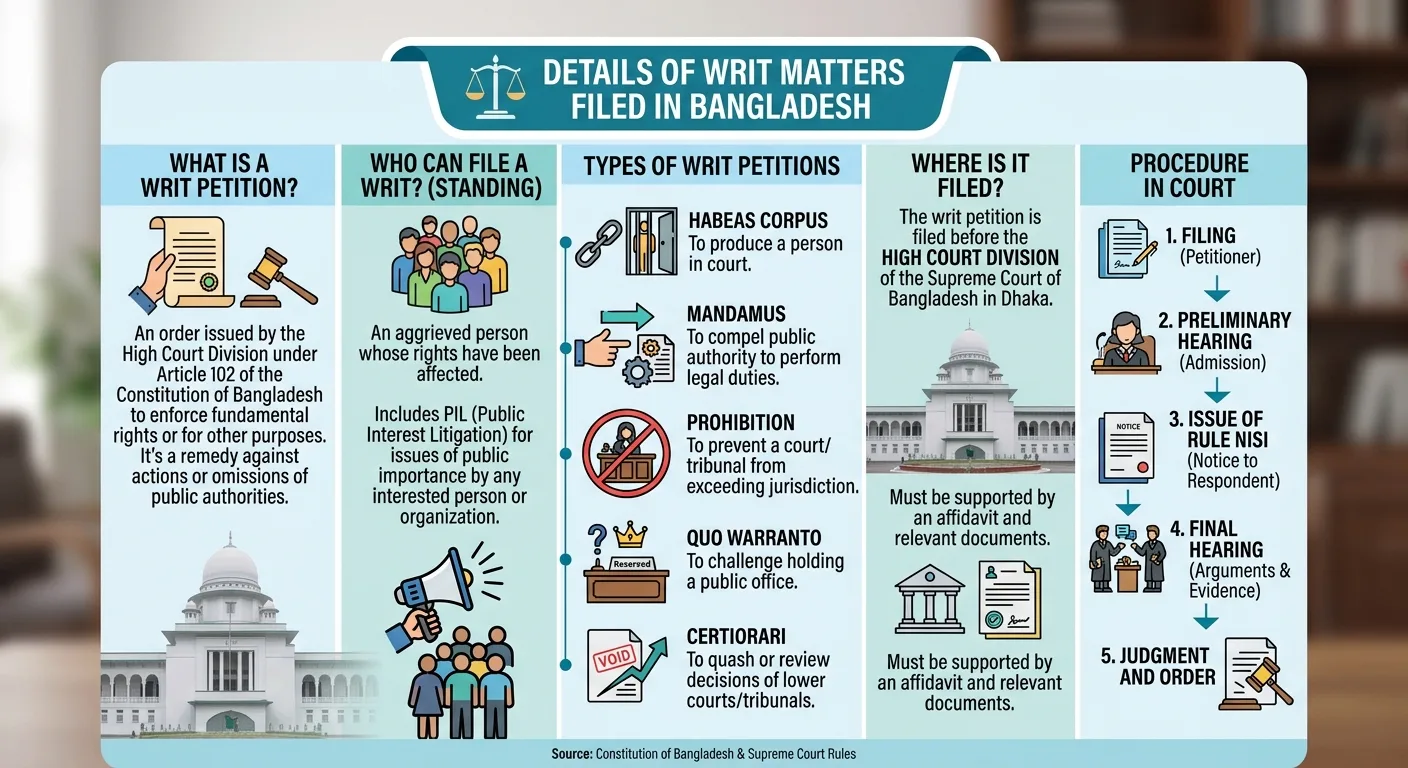
No Legal Remedy in the existing Laws, Come to file Writ before the High Court Division of Supreme Court of Bangladesh. Representation before the highest court — writ petitions, appeals, and constitutional matters before the High Court Division, with Appellate Division matters prepared and led by senior counsel.
The Supreme Court of Bangladesh has two divisions: the High Court Division and the Appellate Division. Matters here include writ petitions — the judicial review of action by the State or a public authority — together with appeals and revisions from the lower courts, and certain matters within the High Court Division’s original jurisdiction.
Litigation at this level rewards careful preparation: the strength of a writ or appeal often rests on how precisely the grounds are framed and how well the record is assembled. The chamber’s focus is on getting that foundation right before a matter is filed.
When you might need this
- A decision or action by a government body or public authority has affected your rights or property.
- You wish to appeal or seek revision of a judgment from a lower court or tribunal.
- Your matter raises a constitutional or fundamental-rights question.
- You need bail or interim relief that only the higher court can grant.
In Bangladesh, Writ Matters are extraordinary constitutional remedies exercised exclusively by the High Court Division (HCD) of the Supreme Court of Bangladesh under Article 102 of the Constitution. They function as a primary mechanism to protect fundamental rights (Part III, Articles 26–47) and enforce administrative accountability against unlawful state action.
Constitutional Provisions: Article 102
Article 102 is divided into two primary limbs:
- Article 102(1) — Enforcement of Fundamental Rights: Grants the HCD original jurisdiction to issue orders or directions to any person or authority for enforcing rights guaranteed under Part III of the Constitution.
- Article 102(2) — Supervisory & Judicial Review Jurisdiction: Provides remedies against state actors, local authorities, and inferior tribunals when legal duties are violated, powers are exceeded, or statutory procedures are breached.
The 5 Types of Writs in Bangladesh
- Writ of Habeas Corpus ("To have the body")
- Purpose: Protects personal liberty against unlawful detention or imprisonment.
- Scope: Commands the detaining authority (police, jail authorities, or private individuals) to bring the detenu before the Court to verify the lawfulness of their custody.
- Note: Parallel statutory relief exists under Section 491 of the Code of Criminal Procedure (CrPC).
- Writ of Mandamus ("We command")
- Purpose: Compels a public official, statutory body, or government authority to perform a mandatory statutory or public duty.
- Scope: Cannot be used to enforce private contractual obligations or discretionary powers, unless the exercise of discretion is arbitrary.
- Writ of Certiorari ("To be certified")
- Purpose: Corrective remedy to quash or annul illegal orders passed by lower courts, administrative bodies, or quasi-judicial tribunals.
- Grounds: Excess of jurisdiction, failure of natural justice, or errors of law apparent on the face of the record.
- Writ of Prohibition
- Purpose: Preventive remedy issued to stop lower courts, tribunals, or administrative bodies from proceeding with a case outside their jurisdiction.
- Difference from Certiorari: Prohibition stops an ongoing illegal proceeding, whereas Certiorari quashes an order that has already been passed.
- Writ of Quo Warranto ("By what authority?")
- Purpose: Challenges an individual’s legal title or qualification to hold a public office.
- Scope: Prevents the usurpation of public office by unauthorized persons.
Our Approach
Where there is no remedy in the existing Law of the Country or violation of someone's fundamental rights, there is only one remedy open for them "File a Writ Petition before High Court". Our Experts will give you complete support from filling writ to give you final remedy.
- Writ petitions (judicial review of public-authority action)
- Civil and criminal appeals and revisions
- Preparing applications for leave to appeal to the Appellate Division (with senior counsel)
- Bail and interim relief at the higher court
- Constitutional and fundamental-rights matters