
Retired, dismissed, removed, or discharged from public service.
The Administrative Tribunal System in Bangladesh serves as a specialized judicial framework designed to address disputes concerning public service. Established under Article 117 of the Constitution of Bangladesh and governed by The Administrative Tribunals Act, 1980, these tribunals offer an efficient, dedicated legal venue for government servants and public employees.
An application can be filed by:
Current civil servants or government employees.
Retired, dismissed, removed, or discharged public servants.
Employees of statutory public authorities listed in the schedule of the Act.
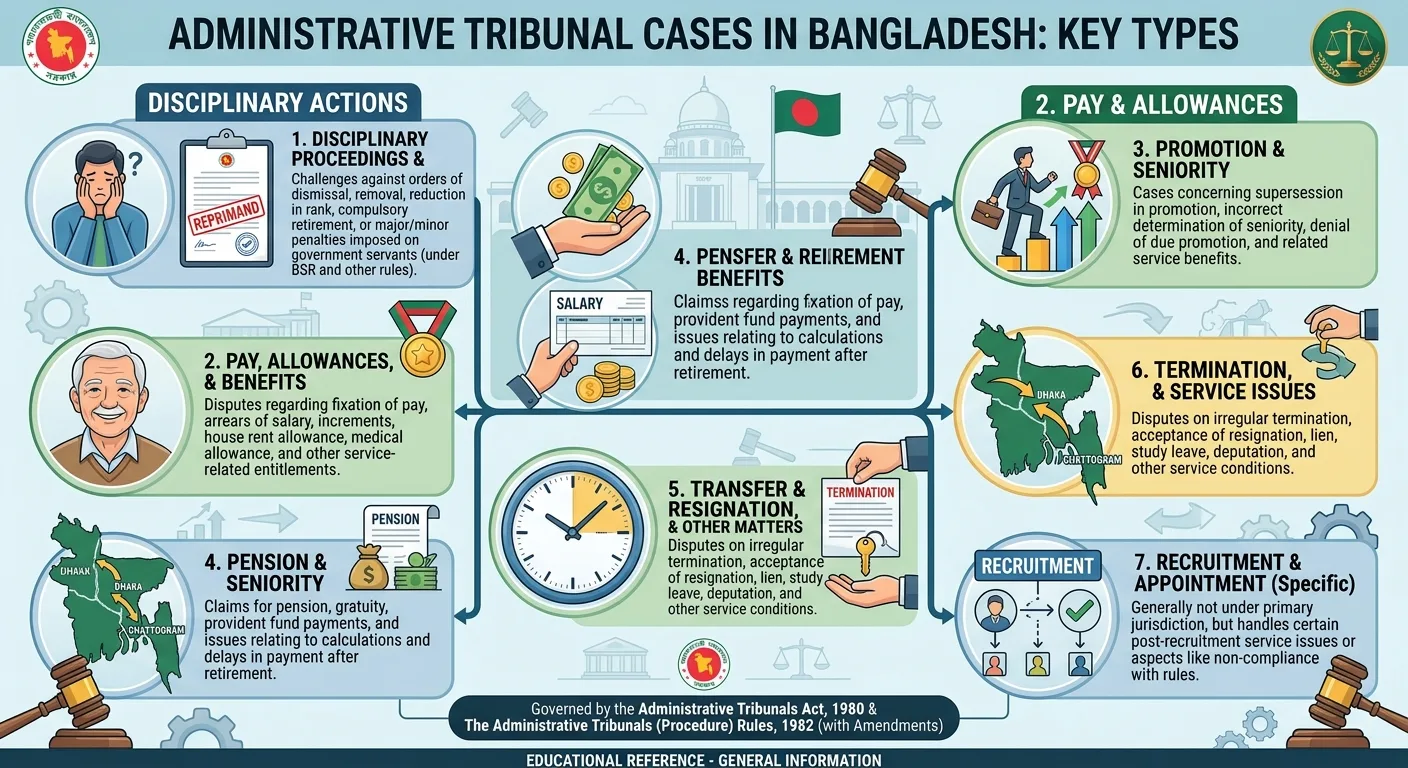
Administrative Tribunals handle a wide range of employment and service-related grievances, including:
Departmental Disciplinary Actions: Challenges against major or minor penalties such as dismissal, removal, forced retirement, or reduction in rank.
Promotion & Seniority Disputes: Denial of due promotion, improper fixation of inter-se seniority, or violation of promotion rules.
Pay, Allowances & Fixation: Non-payment or erroneous calculation of salary, arrears, scale adjustments, or allowances.
Pension & Post-Retirement Benefits: Unreasonable delays, withholding, or reduction of pension, gratuity, or leave encashment benefits.
Transfer & Posting Issues: Arbitrary or punitive transfer orders made in violation of service regulations.
Termination of Service: Illegal termination or discharge of contractual/probationary government employees.3
Navigating a case through the Administrative Tribunal requires adherence to statutory timelines and procedural steps.
Before approaching the Tribunal, the aggrieved individual must first appeal to the higher administrative authority within their department.
The departmental authority has 2 months to decide on the internal appeal or review.
If no decision is rendered within 2 months, it is legally deemed as rejected, paving the way to file before the Tribunal.
An application to the Administrative Tribunal must be filed within 6 months from:
The date the final departmental order/decision was communicated, OR
The expiration of the 2-month departmental appeal window.
The case is initiated by submitting a written application containing:
Full details of the applicant and the respondent (usually the ministry, department head, or government authority).
Precise statement of facts, cause of action, and supporting documents.
Specific legal relief sought (e.g., reinstatement, restoration of seniority, release of pension).
Payment of the prescribed nominal court/application fee.
Notice & Response: The Tribunal issues a notice to the respondent authority, ordering them to file a Written Statement (WS) defending their decision.
Hearing Date: After the submission of the written statement, the Tribunal sets a date for arguments.
Evidentiary Powers: The Tribunal holds civil court-like powers under the Code of Civil Procedure (CPC) to summon witnesses, demand public records, and examine affidavits.
Upon hearing both sides and evaluating the records, the single-member Tribunal (headed by a current or former District Judge) delivers its judgment.
The decision of an Administrative Tribunal is not the final end of the legal road.
Who files: Any party dissatisfied with the Administrative Tribunal’s judgment.
Time limit: Must be filed within 3 months of the original order (extendable up to 6 months upon showing sufficient cause).
Composition: The Appellate Tribunal consists of a Chairman (qualified to be a Supreme Court Judge or Additional Secretary rank) and two members.
If a party remains aggrieved by the decision of the Administrative Appellate Tribunal, they can prefer an appeal to the Appellate Division of the Supreme Court of Bangladesh by seeking Leave to Appeal under Article 103 of the Constitution.
Strict Timelines: Missing the 6-month filing window can bar you from getting legal relief.
Document Trail: Maintain copies of all departmental communications, joining letters, promotion notifications, and administrative appeals.
Legal Representation: Hiring a advocate experienced in service laws ensures correct drafting and proper handling before the tribunal.
We work as an extension of your team, combining technical excellence with a deep understanding of the Bangladeshi regulatory environment. Every engagement is led by a partner and supported by specialists, ensuring continuity and accountability throughout.