
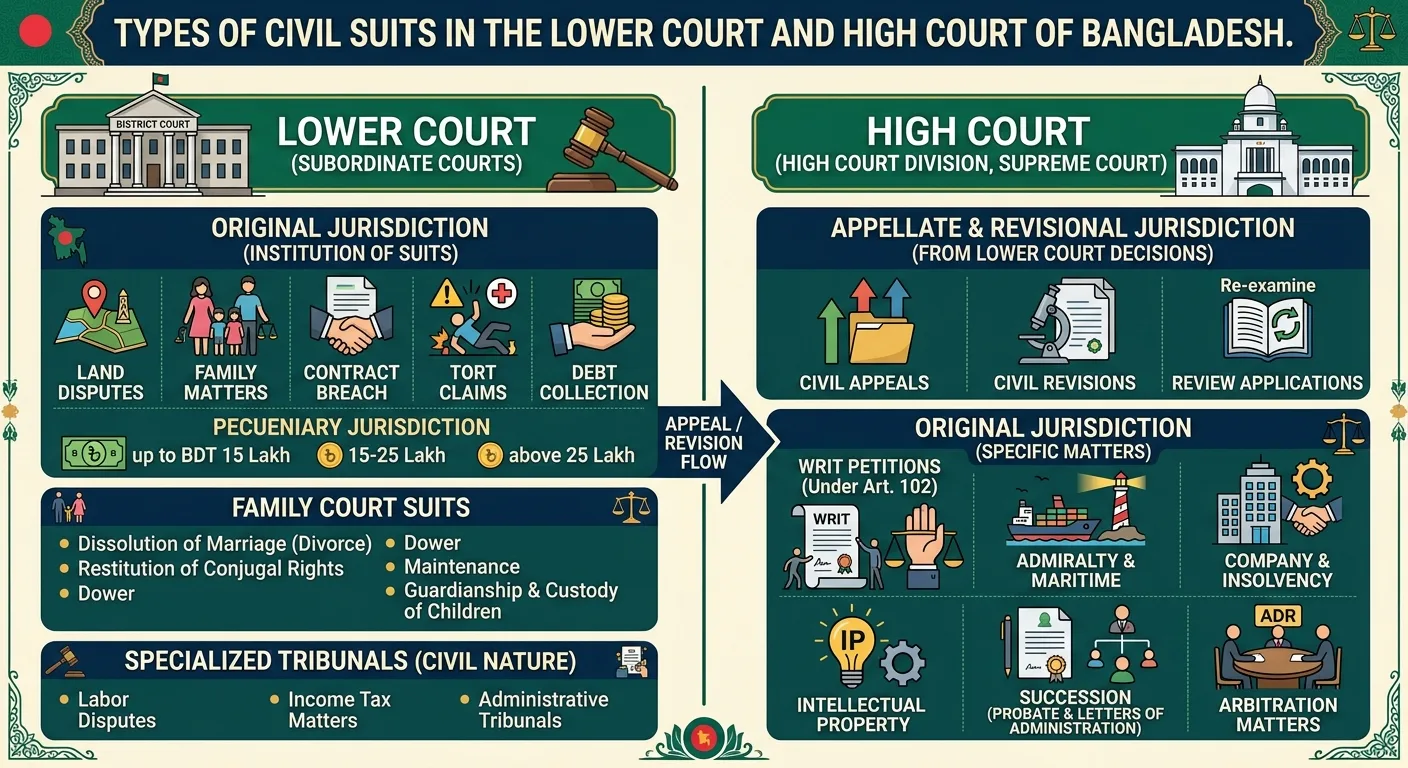
Resolving private disputes — contracts, money, title, partition and injunctions, Property Related Suits, Family Suits, Civil Appeal. Civil Revision— through the civil courts.
Civil litigation covers private disputes between people and businesses — contracts, money claims, property title, partition, declaration, injunction, specific performance, and tenancy — conducted largely under the Code of Civil Procedure. A suit is filed in the civil court that has jurisdiction over the value and subject matter, with appeals and revisions running upward.
Many civil disputes can be narrowed or settled with the right early strategy. Where they cannot, the chamber prepares the suit carefully so the case is presented on its strongest footing.
Types of Civil Suits in Lower Courts
Lower courts—comprising Joint District Judge Courts, Senior Civil Judge Courts, and Civil Judge Courts—handle the vast majority of original civil trials, categorized by pecuniary (financial) jurisdiction and subject matter:
·Suit for Title and Recovery of Possession: Filed when a person's ownership (title) over immovable property is disputed or when they have been illegally dispossessed (under Section 8 and 9 of the Specific Relief Act, 1877).
·Suit for Partition: Instituted by co-sharers or joint owners to physically divide joint family property or shared land so each party receives their exclusive legal share.
·Suit for Specific Performance of a Contract: Filed to compel a party to fulfill their obligations under a legally binding contract, most commonly seen in agreements for the sale of immovable property.
·Suit for Permanent and Temporary Injunctions: Filed to restrain a defendant from committing an act that violates the plaintiff’s legal rights, such as illegal construction or trespassing on disputed land.
·Money Suits: Instituted to recover outstanding debts, damages for breach of contract, unpaid loans, or compensation for civil wrongs (torts).
·Suit for Declaration: Filed under Section 42 of the Specific Relief Act to establish a legal status, right to property, or character (e.g., declaration of title, declaration of tenancy, or challenging a fraudulent deed).
·Mortgage and Redemption Suits: Filed by mortgagees to recover loan amounts through the judicial sale of mortgaged property, or by mortgagors to redeem property after paying off the debt (Order 34 of the CPC).
·Matrimonial and Family Suits: Handled by Family Courts (functioning within the lower judiciary), covering suits for dissolution of marriage, dower (mahr), maintenance, and custody of children under the Family Courts Ordinance, 1985.
Reviewing the dispute and, where useful, issuing notice before suit.
Filing the plaint; the court issues summons and the defendant files a written statement.
The court settles the issues to be decided.
Evidence is led and tested, followed by arguments.
Judgment and decree are passed; a decree may then be executed. Appeal lies where there are grounds.
Civil Appeal
Civil Revision
Suits in the Land Survey Tribunals
Mutation of Land
Land related legal Opinion
Our Team is Commited to give you best solutions both in Chamber and in the Court to solve your Civil Issues.